‘Cause once you get the roamin’ fever
You never want to settle down
- Ry Cooder, Boomer’s Story
“I’ll miss you guys! Have fun! Call when you can!”
I watched as my wife and two children slowly worked their way through airport security, turned one final time to wave goodbye, then disappeared into the bowels of the airport. Rebecca had done this to me before, leaving me for long stretches of time to pursue some silly dream of hers. I distinctly remember at the beginning of our relationship when she left me in New Jersey for a year so she could go to London to earn her Masters of Law in International Human Rights. It was palpable how, as I watched her go through the gate and board the plane, the cloud of melancholy settled, enveloping me in sadness and uncertainty.
Not this time. My wife of many, many years had just flown out of what little hair I had left for the next six weeks to travel around Colombia and had taken our 14-year-old daughter and 11-year-old son with her. As soon as I was sure they couldn’t see me, I did a Lucky Charms leprechaun jump, the one where Lucky taps the soles of his patent leather, buckled shoes together. Then I skipped to the parking garage, slipped AC/DC’s “For Those About To Rock (We Salute You)” into the CD player of our minivan, drove home, and went to sleep. Even though as much hell as could be raised by a 44-year old married man was about to be raised, I still had to go to work the next morning.
But during the course of the next six weeks I had almost as much fun as a married man with children who wants to remain a married man with children can have. I ate red meat for dinner every night. I played all of the loud music records that I never got to play. I left my dirty clothes in a pile on the floor. I picked the movie on family movie night for six weeks in a row. I slept in the middle of the bed.
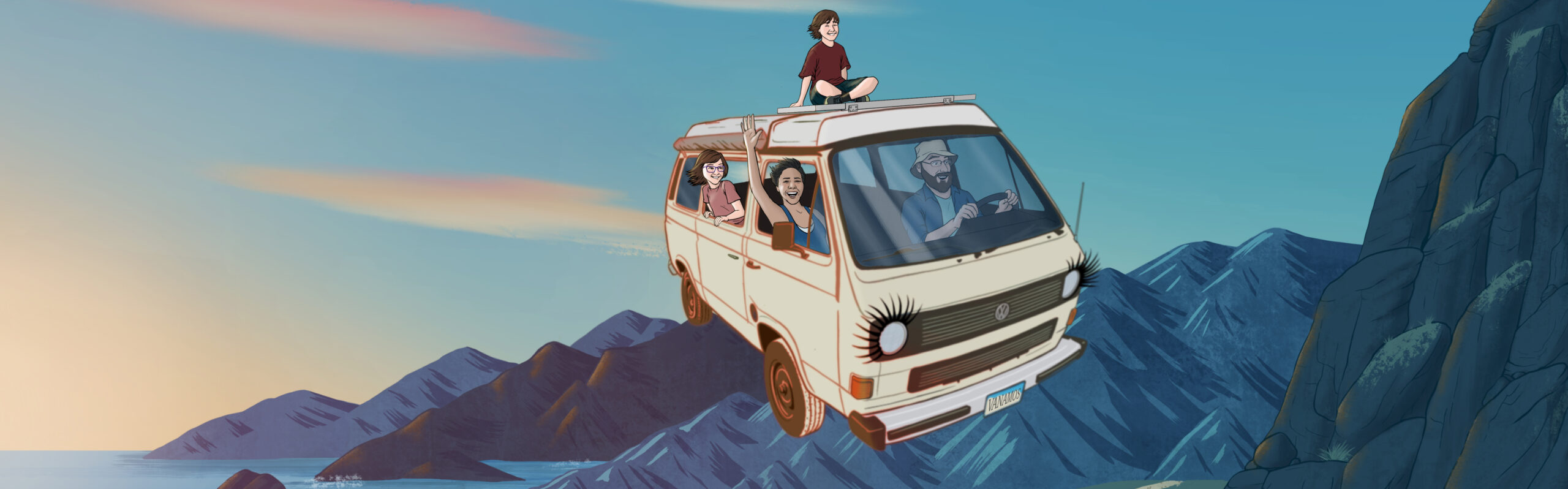
The transcendent moment, however, was driving our 1985 Volkswagen Westfalia camper van to Norfolk to see a Green Day concert. It was the same van we had driven from our home in Virginia to Panama and back the previous year. It felt good to get on the road again, even briefly. And as I eased our Westy, which we had named Wesley, along the sun-speckled roads of coastal Virginia to Chippokes State Park, where I had a reservation to camp for one night before the Sunday evening concert, I felt the same good feelings I had during our overland trip. Freedom, wonderment, contentment. A short hike through the fields and along the beach, a campfire and a couple of beers, and a restful night under the stars only enhanced my feelings of wellness and good fortune. And I hadn’t even seen the show yet.
After the concert, which was awesome and gave me a new respect for the band, I fluffed my pillow and lay down to sleep in Wesley while still parked in the arena parking lot. It felt good to buck the mainstream, eschew the Holiday Inn, and subject myself to a potential citation for vagrancy. But the cold fingers of the fading winter still had a hold on the darkest parts of the night, and I woke from the chill at two in the morning. Rather than snuggle down deeper into the thin sheets that we had used as bedding on our sojourn south of the border, and that were still stacked in the linen closet of the van, I decided to drive back to Alexandria so I could go to work the next morning. I preferred to save the vacation day for an actual vacation, rather than burning it to drive several hours in morning traffic on Interstate 95 to my house, where all I would probably do was make a peanut butter and jelly sandwich and dust the shelves.
So my happy little diversion from routine came to an end. But it left me with something: the recurrence of that feeling of wanting more. More excitement. More experiences. Less of the same. The irony is that it’s easy to push thoughts of restlessness and dissatisfaction down when your days are occupied by banality. By the time Rebecca and the kids arrived back home on my birthday, I was six weeks older and ready to re-engage in family domesticity. But Rebecca, as usual, had other plans.
“What do you think about moving to Mexico?” she asked.
“I think it’s a great idea,” I replied. “Who’s moving to Mexico?”
“What do you think about us moving to Mexico?” Rebecca rephrased the question.
“Hmm,” I said. What did I think about that?
This was in April 2017. In 2015 and 2016, Rebecca and I had taken a year leave of absence from our lawyer jobs, pulled our daughter Maya out of seventh grade and our son Jonah out of fourth grade, purchased Wesley, and spent the year driving from our home in Alexandria, Virginia, across the southern United States, then through Mexico, Guatemala, El Salvador, Honduras, Nicaragua, Costa Rica, and Panama. Then we turned around and drove back.
The trip lasted twelve months, and it was the kind of trip where, if you survived it, you couldn’t expect to just go on living the life you had been living before. But Rebecca and I were naive. We had never taken a year off from our careers and traveled across seven countries with no itinerary or return ticket. So picking up the reins to our prior life is exactly what we expected to do after we returned. After all, that’s what you do when a vacation ends, you go back where you came from and keep doing the things you were doing. I guess we thought of our year-long trip as an extended vacation. A much longer and cooler vacation than we’d ever taken, but nonetheless, something that we would come back from.
We knew it would change us in some ways, but we didn’t understand how it would fundamentally shift our perspective on life. So when we returned, we went back to our jobs, put the kids back in school, and tried to carry on like we had been doing for the fifteen years before we made the trip. Except now, the prospect of doing that same thing for many more years until we were septuagenarians and could retire didn’t sit so well.
It was like eating a dog meat taco. If you don’t know you are eating one, it tastes pretty good. But once someone tells you what you are chowing down on, you feel sick. That’s how we felt about our life in Alexandria. Before the trip, we were ignorant and happy to go on chewing. But afterwards . . . well, we knew what we were being fed and we didn’t want it anymore.
Rebecca had fallen into a deep depression upon our return from the year long trip from which not even an unlimited supply of Trader Joe’s grape leaves could rouse her. I was dispirited as well, but didn’t understand it for what it was. I was just resigned to life as we lived it. I couldn’t help Rebecca. Maya and Jonah, well, they were kids, so who knows what was going on in their heads. They went to school, came home, and stalled at bedtime just like they had always done.
The dullness didn’t leave Rebecca from the time we returned to Alexandria in August 2016 until January 2017, when our friend Melissa, whom we had met in Mexico during our return drive to the US, called and said she was going to Colombia with her three children and did Rebecca want to go as well? Of course she wanted to go.
So plans were made, again. First, to pull the kids out of school. Only this time, it felt more empowering. We were telling the school what we were going to do instead of asking permission, as it felt we were doing the first time around.
Next, to put Rebecca’s immigration law practice on hold. Rebecca was confident things wouldn’t blow up there. She knew the US immigration system moves at a snail’s pace and that nothing would happen in six weeks while most of her clients were still in frustrating limbo as their cases inched their way through the process.
Clothes were folded, bags were packed, reservations made. The familiar vitality with which Rebecca faced most days returned in a big way as she planned this new and exciting adventure. And then, in the middle of March, they were gone to Colombia.
During their absence, on our “whenever-they-had-a-signal” phone calls, I heard stories of a market in Villa de Leyva that sold almond butter that tasted like hummus and a cafe that served an amazing cilantro soup. Both Maya and Jonah gushed about paragliding in the adventure capital of San Gil. Rebecca was amazed that, after the waterfall she was rappelling down battered her into the rocks, the x-ray she needed to ensure she only had bruised ribs cost just $20.
They all laughed about having to fit both families, seven people in total, into a taxi the size of a Mini Cooper, but only one person could sit in the front passenger seat in case the police saw them. I heard about playing in the pools and tubing on the natural water slides of Curiti, digging for dinosaur bones, and searching the Caribbean Sea for pirates from the ramparts of a castle in Cartagena. Basically, they were having experiences that blew away anything happening in my world. I didn’t bother to tell them I had cleaned the refrigerator. Let them be surprised when they come home, I thought.
When they did get back, Rebecca’s natural tendency to want to shake things up would not be shaken. Of course, I was the one who would have done the shaking, and frankly, I wasn’t much in the mood for it. Don’t forget, I had recently been to that Green Day concert.
So when I was presented with the choice to continue to go to a desk job in Washington DC for the next fifteen years or quit and move to Mexico, even I had enough sense to see that there wasn’t much of a choice. Though, Rebecca continues to this day to give me credit for not poo-pooing the idea, so I shouldn’t undersell the gravity of the choice we had to make.
And really, it was a hard decision to make such a drastic change in our lives. On the one hand, the part of me that still pined for the freedom and possibilities of each day that I had felt when we were on the road for the year, that had been re-fired when I heard Green Day sing about not wanting to be an American Idiot, was absolutely on board. No questions asked. But I’m also made up of practical parts. Those parts worried about whether we could afford it, whether the kids would hate us, whether it was the right choice.
To some extent, these were the same concerns we had when we decided to drive through Mexico and Central America, but taken to another level. After we had done our research in anticipation of the year-long trip, it felt less risky. We felt good about our safety, the kids’ education, and our finances. Plus, it was only a year and then we were coming back.
But moving to Mexico on a permanent basis, this was real change. I would be quitting my job, not just taking a leave of absence. Rebecca would leave her law practice. With no jobs, how would we pay for tacos?
We would sell our car, not put it on blocks in the front yard. I grew up in New Jersey, where it is the law that you must own a car from the day you get your drivers’ license. For me, that was thirty years of car ownership. Just the prospect of being without a car raised so many questions.
We decided not to sell our house. Instead, we would rent it, taking some pressure off us to hit the Mexican ground running in the money making department. But that meant other people would be living in our house. What if we decided to come back? There was no room for us anymore.
We were going to get a dog when we got to Mexico. Would it like me?
Rebecca and I pondered all of these questions. But, you know, it kind of came down to this: a wise friend had once described to us his philosophy on risky propositions, “What’s the worst that can happen? You hate it and completely ruined your life?”
Well, yeah, that. So when Rebecca asked, “What do you think about us moving to Mexico?”
After some consideration, I said, “Yeah. Let’s do it.”
So that’s where we found ourselves. Hand in hand, going down to Mexico.